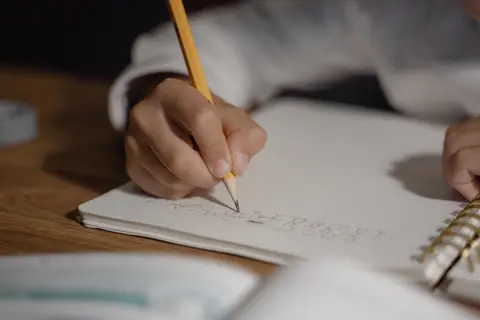
You're staring at the same problem you've been staring at for ten minutes. Your brain feels stuck, your hand wants to grab your phone, and a little voice is whispering, just look up the answer and move on. You're not lazy and you're not bad at this. You've just hit the part of homework that actually matters.
That stuck feeling has a name: productive struggle. It means staying with a hard problem a little longer on purpose, working through the confusion yourself instead of reaching for the answer the second it gets uncomfortable. The struggle is not a sign you're failing. It's the moment your brain is doing the real work of learning, and learning to lean into it is a skill you can practice tonight.
What productive struggle actually means
Here's the part nobody tells you: feeling confused is not the same as being lost. When a problem feels hard, your brain is making new connections, testing what it already knows, and figuring out what's missing. That effort is exactly what makes the idea stick.
The opposite move is what most students do without thinking. You get stuck, you flip to the answer key or paste it into an AI, you copy the steps, and you feel fine. The problem is solved, but you didn't learn it. Tomorrow on the quiz, with no answer key in sight, it's gone.
Productive is the key word. Struggle that goes nowhere — staring blankly, panicking, or rereading the same line twenty times — isn't helping anyone. The goal is struggle with a plan: a few real attempts, a clear sense of what's confusing you, and help that arrives after you've tried, not instead of trying.
How to lean into productive struggle yourself
You don't need more willpower. You need a few moves you can run when that stuck feeling hits. Pick one or two of these tonight.
-
Set a "wrestle timer" before you reach for help. When you hit a wall, decide in advance how long you'll work on it alone — a few minutes for a quick problem, longer for something meaty. Set a timer if it helps. The point isn't the exact number; it's giving your brain a real shot before you hand the problem to someone else. Often you'll crack it before the timer ends — and even when you don't, you've made the struggle productive.
-
Name exactly what's confusing you. Don't let "I don't get it" be your whole thought. Finish the sentence: I don't get how to start, or I get the first step but not the second, or I don't know what this word means. The moment you name the gap, you've turned a vague wall into a specific door — and a specific question is one you can actually solve or ask about.
-
Reread the example before you reread the question. When you're stuck, your instinct is to read the problem again and again. Instead, go back to a worked example in your notes or textbook and walk through it slowly. Then come back to your problem and ask, what's the same, and what's different here? You're not looking for the answer; you're looking for the move.
-
Try a wrong attempt on purpose. A blank page is scarier than a wrong one. Pick any reasonable first step and actually do it, even if you're not sure. A wrong attempt shows you something true: it tells you which path doesn't work and usually hints at which one does. You can't fix a guess you never made.
-
Ask a question, not for the answer. When you do get help, protect your own learning. Instead of "what's the answer," ask "is my first step right?" or "can you explain why this rule applies here?" That keeps the thinking yours. A good question gets you unstuck without skipping the part that teaches you.
-
Take a real break, then come back once. If you've genuinely wrestled and you're still stuck, step away for a few minutes — get water, stretch, do a different subject. Your brain keeps working in the background. Come back and try one more time before you ask. You'll be surprised how often the answer shows up after the break.
A worked example: leaning in instead of looking up
Say your homework has this: A rectangle's length is 3 cm more than its width. The perimeter is 26 cm. Find the width. You read it, and nothing happens. Stuck.
The look-it-up move: paste it somewhere, copy "width = 5," write it down, done. You learned nothing.
The productive-struggle move looks like this. First, name the gap: I don't know how to turn the words into math. That's useful — the issue isn't perimeter, it's translation. Next, reread what you know: perimeter means all four sides added up, and a rectangle has two lengths and two widths. Now try a wrong-ish attempt: call the width w. Then the length is w + 3. Write the perimeter as w + w + (w + 3) + (w + 3). Maybe you're not sure it's right — write it anyway.
Look at what you built. You don't have the answer yet, but you turned a sentence into something you can work with, and that was the hard part. If you're still stuck from here, your question is now sharp: "I set it up like this — is my equation right?" That's a question worth asking, and you earned it.
How you know it's working
Productive struggle doesn't always feel good in the moment, so don't judge it by comfort. Judge it by these signs:
- You can say out loud what you tried and what's confusing you — not just "I don't get it."
- You're making attempts on paper instead of staring or scrolling.
- When you finally get help, it clicks fast, because you'd already done most of the thinking.
- A day later, you can redo a similar problem with the book closed.
That last one is the real test. Close the notebook, find a fresh problem of the same type, and try it cold. If you can, the struggle paid off. If you can't, you found exactly what to practice next — which is also a win.
|
The point of homework isn't a finished page. It's a brain that can do the thing tomorrow, when no one's there to look it up for you. |
Try it tonight
Tonight, pick the one homework problem you'd normally skip or look up. Before you touch your phone, give it a real wrestle: set a timer, name what's confusing, try one wrong step, reread an example. See how far you get on your own. You don't have to finish it perfectly. You just have to stay in the struggle a little longer than usual — that's the whole skill.
Want this to become a habit, not a one-off? hello.study turns it into a few-minute daily habit — start free →
Common questions
How long should I struggle before asking for help?
Long enough to make a real attempt, not so long that you spiral. Try a few honest tries first — read an example, write a wrong step, name what's confusing. If you've done that and you're still stuck, it's time to ask. The rule isn't a clock; it's "effort first, then help."
Isn't it faster to just look up the answer?
Faster tonight, slower forever. Copying an answer finishes the page but skips the learning, so the same problem trips you up on the quiz. Wrestling with it now means you actually own it later — which saves you from re-learning it in a panic before the test.
What if I struggle and still can't solve it?
That's still a win, as long as you tried. The goal isn't to solve everything alone — it's to make a real effort so you know exactly what's confusing you. Then ask a sharp question, like "is my first step right?" You learn more from a struggle that ends in a good question than from an answer you copied.
How is this different from just being frustrated?
Frustration is spinning in place — rereading the same line, panicking, or giving up. Productive struggle is moving forward, even slowly: trying steps, naming the gap, testing ideas. If you're making attempts and learning what doesn't work, that's productive. If you're just stuck and stressed, take a short break and come back with one new approach.