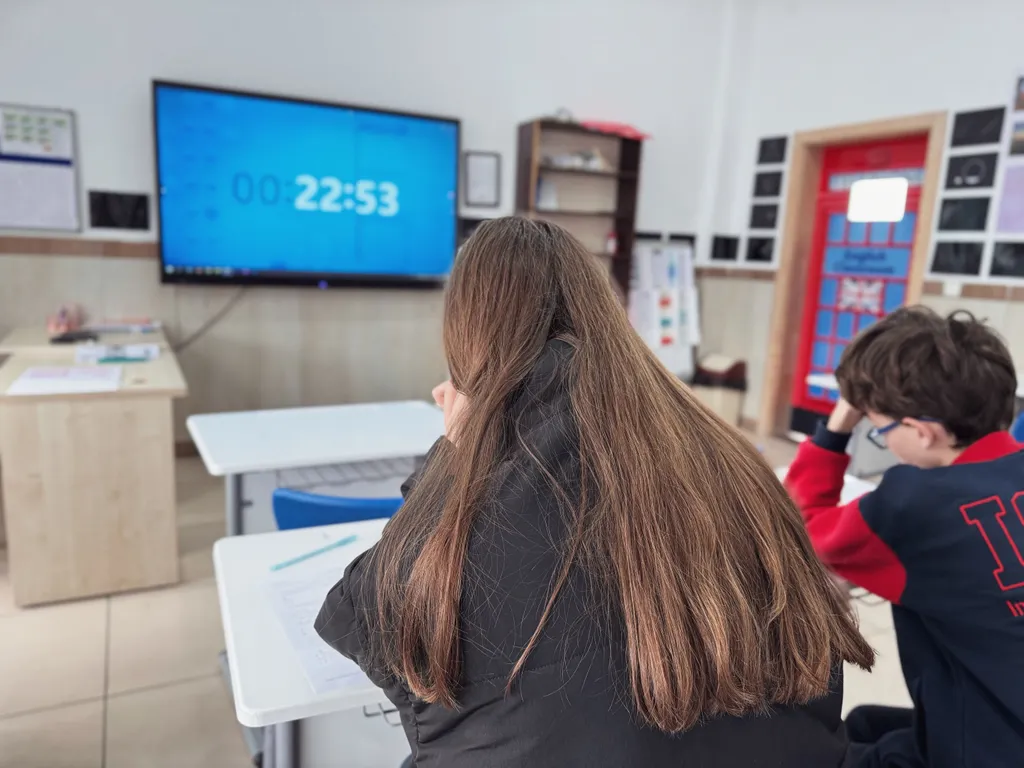
Here's the fix in one line: instead of telling yourself to "study until it's done," give the task a time-boxing window — pick a small, fixed amount of time (say 20 minutes), set a timer, and work on one thing until the timer stops. The deadline does the motivating for you.
What time-boxing actually means
Time-boxing is just this: you decide how long you'll work before you start, not how much you'll finish.
Most studying has no edges. "Do my science homework" could take ten minutes or two hours, and your brain has no idea, so it quietly panics and avoids the whole thing. A time box gives the task edges. You're not promising to finish — you're only promising to show up for 20 minutes. That's a much easier promise to keep, which is exactly why it gets you started.
And starting is the part that matters. Almost nobody quits a study session five minutes in. The hard part is the first five minutes — and a timer shrinks that wall down to something you can step over.
The method: how to run a time box
You don't need an app, a planner, or a fancy system. You need a clock and four moves.
-
Pick ONE task and name it out loud. Not "do homework" — say exactly what the box is for: "read pages 40 to 46" or "do the first ten algebra problems." A vague box invites wandering. A named box has a finish line your brain can see, even if you don't reach it.
-
Set the box small — 15 to 25 minutes to start. Long enough to get real work done, short enough that the end is always in sight. If 25 feels heavy on a low-energy night, drop to 15. The goal is a box you'll actually start, not the most impressive number.
-
Start the timer, then work on that one thing only. When the urge to check your phone shows up — and it will — tell yourself not now, after the timer. You're not banning the distraction forever. You're just parking it for 18 more minutes. That reframe is far easier to obey than "no phone, period."
-
When the timer rings, stop and take a real break. Stand up, get water, look out a window for 5 minutes. The break isn't a reward you have to earn by finishing — it's part of the system. Then decide: another box, or done for now. Either is a win, because you worked.
That's the whole method. The magic isn't in the number on the timer. It's that a closed-end window turns "study forever" into "study for 20 minutes," and your motivation only ever had a problem with the first version.
Not sure how big your box should be? Pick the size you're 90% sure you'd actually start tonight, tired. If part of you is bargaining, the box is too big — make it smaller. A box you start beats a box you admire.
A worked example: a chapter of reading
Say you've got a history chapter due tomorrow — pages 40 to 60, twenty pages, and you'd rather do almost anything else.
The "study until it's done" version is a two-hour cliff. Of course you're avoiding it. So box it instead:
- Box 1 (20 min): "Read pages 40 to 47 and jot one sentence per section on what it was about." Timer on. When it rings at 20, you've read seven pages and you stop — even if you're mid-section.
- Break (5 min): Stand, stretch, water. No screen if you can help it.
- Box 2 (20 min): "Read 48 to 54, same one-sentence notes." Ring. Stop.
- Decide: You've done fourteen pages in two short, finite sprints. Maybe you run one more box, maybe you finish tomorrow morning. Either way you went from zero to most of the chapter — and you never had to face the two-hour cliff.
Notice what we did not do: we didn't tell you what those history pages say or do the assignment for you. That's yours. We're handing you the way to get through it, not the answers — because the goal is for you to learn the chapter, not to skip it.
The same shape works on math ("the first 8 practice problems, 20 minutes"), on an essay ("one rough paragraph, 15 minutes, ugly is fine"), on flashcards, on anything that feels too big to start.
How to know it's working
Time-boxing is working when starting stops being the hard part. You won't notice it as a burst of motivation — it shows up quieter than that. Watch for these:
- You sit down and the timer is going within a minute or two, instead of circling the desk first.
- When a distraction pops up, you can park it ("after the timer") instead of chasing it.
- You finish a box and think "that wasn't so bad," and a second box feels possible.
If you're still stalling before the timer even starts, your box is too big. Cut it in half. A 10-minute box you actually begin is worth far more than a perfect 45-minute plan you keep dodging.
|
Motivation isn't what gets you started — a small, finite window is. Motivation is what shows up after you begin. |
Try it tonight
Pick the one assignment you've been avoiding. Don't plan the whole night. Just do this:
- Name one small piece of it out loud.
- Set a timer for 20 minutes (or 15 if you're wiped).
- Work on only that until it rings — then stop and stretch.
One box. That's the whole ask. Do it a few nights in a row and starting quietly gets easier, because you've taught yourself that studying isn't a cliff — it's just a box you can always close.
Common questions
How long should a study time box be?
For grades 5–10, start with 15 to 25 minutes, then a 5-minute break. Shorter boxes are easier to begin, which is the whole point. As focus gets stronger you can stretch to 30 or more — but a box you actually start always beats a longer one you keep avoiding.
What if I don't finish the task before the timer rings?
That's normal and totally fine. Time-boxing measures time worked, not task finished — stopping on the bell is the system working, not failing. Take your break, then run another box if you want. You made real progress in a finite sprint instead of stalling on an endless one.
Isn't this just the Pomodoro Technique?
They're close cousins. Pomodoro is one popular recipe — usually 25 minutes of work, then a 5-minute break, on repeat. Time-boxing is the broader idea: any fixed window you pick for a task. Use Pomodoro's 25/5 if you like a set rhythm, or size your own box to the night and your energy.
What do I do about my phone during a time box?
Put it out of reach — another room, a drawer, face-down across the desk. When the urge to check it shows up, tell yourself not now, after the timer. You're parking the distraction for a few minutes, not banning it forever, and that smaller promise is far easier to keep until the box closes.