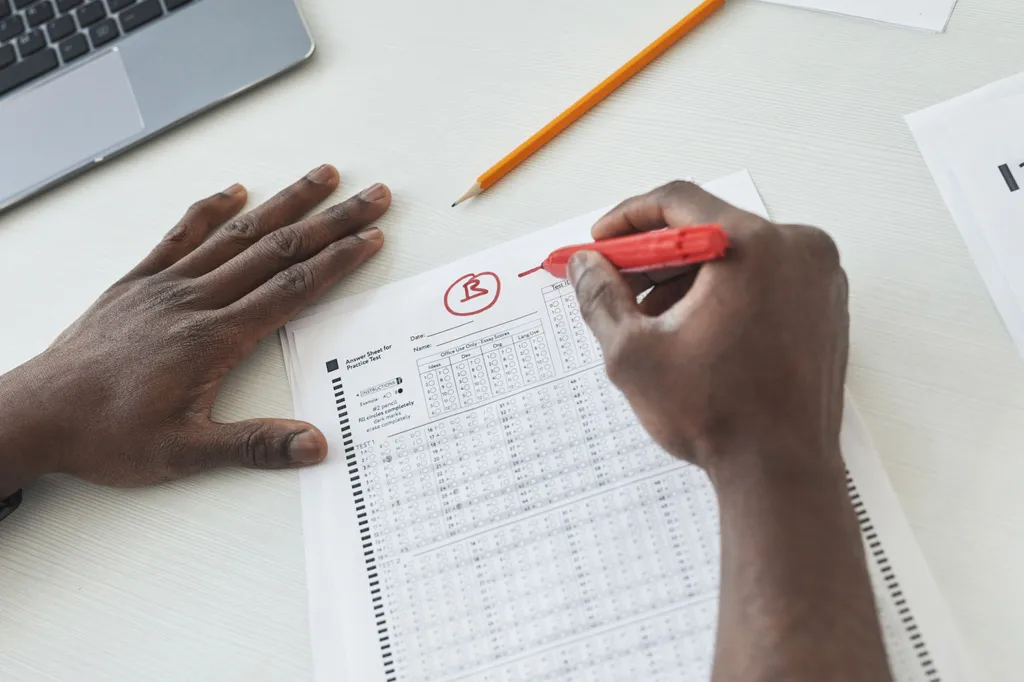
You got a test back covered in red marks, and your first move was to fold it in half and shove it in the bottom of your backpack. You already know what happened: you got those wrong. Looking again just feels bad.
Here's the move that actually raises your grade: learning from mistakes works when you stop hiding the wrong answers and start studying them — because a wrong answer is the most exact study guide you'll ever get. It tells you the one thing you don't know yet, no guessing required.
Why learning from mistakes beats getting it right
When you get a question right, you learn almost nothing — you already knew it. When you get one wrong, the question just handed you a free, personalized list of what to fix.
The wrong answers aren't the score. They're the directions. Top performers in anything — a gamer studying the replay after a loss, an athlete reviewing game film — don't treat a miss as proof they're bad. They treat it as data: information about the exact gap, so the same miss doesn't happen twice.
That reframe is the whole skill. Mistakes aren't a signal to quit. They're feedback telling you where to aim next.
The four moves that turn mistakes into fuel
Don't just glance at the red mark and say "oh yeah, careless." That's how the same mistake comes back next week. Run these four moves on every wrong answer instead.
-
Sort why it was wrong, not just that it was wrong. Every miss falls into a type. Was it a careless slip (you knew it, you rushed)? A concept gap (you genuinely didn't understand)? A misread question (you answered the wrong thing)? Or a memory blank (you knew it last week, not today)? Say the type out loud. The fix for "careless" is slow down; the fix for "concept gap" is go relearn it. They are not the same job.
-
Redo the problem from scratch — covering the right answer. Don't read the solution and nod. Nodding feels like understanding but isn't. Cover the answer, get a blank page, and rework the whole thing yourself until you land on the correct result on your own. If you can't, you found a real gap — good. That's the part worth your study time.
-
Re-test yourself on it a few days later. Fixing a mistake once doesn't make it stick; your brain needs to pull the answer back up after a delay. Put the missed question on a sticky note or a flashcard, and try it again in two or three days from memory. If it's still shaky, it goes back in the pile. If it's solid, it's actually learned.
-
Track your recurring error types. Keep one short running list — a "mistake log" — of the kind of error you keep making, not every single question. After a few entries you'll see a pattern: "I keep dropping negative signs," or "I skip the last step of word problems." Now you know exactly what to watch for before you even start the next test.
A worked example: one missed math problem
Say you got this wrong on a quiz: solve for x: 3(x − 4) = 18. You wrote x = 6. The right answer is x = 10.
Move 1 — sort the why. You didn't multiply the 3 across the parentheses; you only handled the part inside. That's a concept gap in distributing, not a careless slip. Naming it that way points you at the real fix.
Move 2 — redo from scratch. Cover everything and start on a blank page. Distribute first, so 3(x − 4) becomes 3x − 12 = 18. Then add 12 to both sides to get 3x = 30, and divide by 3 to get x = 10. You worked it yourself — that's the part that sticks.
Move 3 — re-test in a few days. Write a fresh one like 2(x − 5) = 8 on a sticky note and solve it Thursday from memory.
Move 4 — log the type. Your mistake log gets one line: "forget to distribute across parentheses." Next quiz, that's the first thing you double-check.
Notice what we did not do: we never just copied the teacher's answer and moved on. The point isn't the answer to that one problem. It's spotting the gap so it never costs you points again.
How to know it's working
Close your notebook. Take the question you got wrong, and try to answer it out loud from memory — no peeking. If you can explain why the right answer is right, not just state it, you've actually learned it. If you stumble, it's not learned yet; it goes back on the sticky note for another round in a couple of days.
A shrinking mistake log is the clearest sign of all. When the same error type stops showing up, that gap is closed for good.
|
Your mistakes already know exactly what to study next. You just have to read them. |
Try it tonight
Pull out the most recent thing you got wrong — one quiz, one homework problem, one flashcard you blanked on. Run all four moves on that single item: sort the why, redo it from scratch, schedule a re-test for a few days out, and add one line to a fresh mistake log. One mistake, fully worked, beats re-reading a whole chapter.
Want this to become a habit, not a one-off? hello.study turns it into a few-minute daily habit — start free →
Common questions
How do you learn from mistakes when studying?
Stop hiding your wrong answers and start studying them. For each miss, sort why it was wrong, redo the problem from a blank page, re-test yourself a few days later, and log the error type. A wrong answer is a free, personalized list of the exact thing you don't know yet.
How do you stop making the same mistakes on tests?
You usually fixed the answer but not the cause. Re-sort the why — you may have mislabeled it. A "careless" error that keeps returning is almost always a hidden concept gap. Relearn the underlying step from scratch, then re-test it a few days later to confirm it actually stuck.
Is it bad to look at the answer key?
Looking is fine; copying isn't. Use the answer key to check yourself after you've tried the problem, or to find the step where you went wrong. The trap is reading the worked solution, nodding, and calling it learned. Always close the key and redo the problem from a blank page on your own.
How do you review a test you got back?
Don't just scan the red marks. Go through each wrong answer and sort why you missed it, then look for patterns across the whole test — the error types that show up again and again. Redo the gaps from scratch and log the repeat offenders so the same misses don't cost you points next time.